

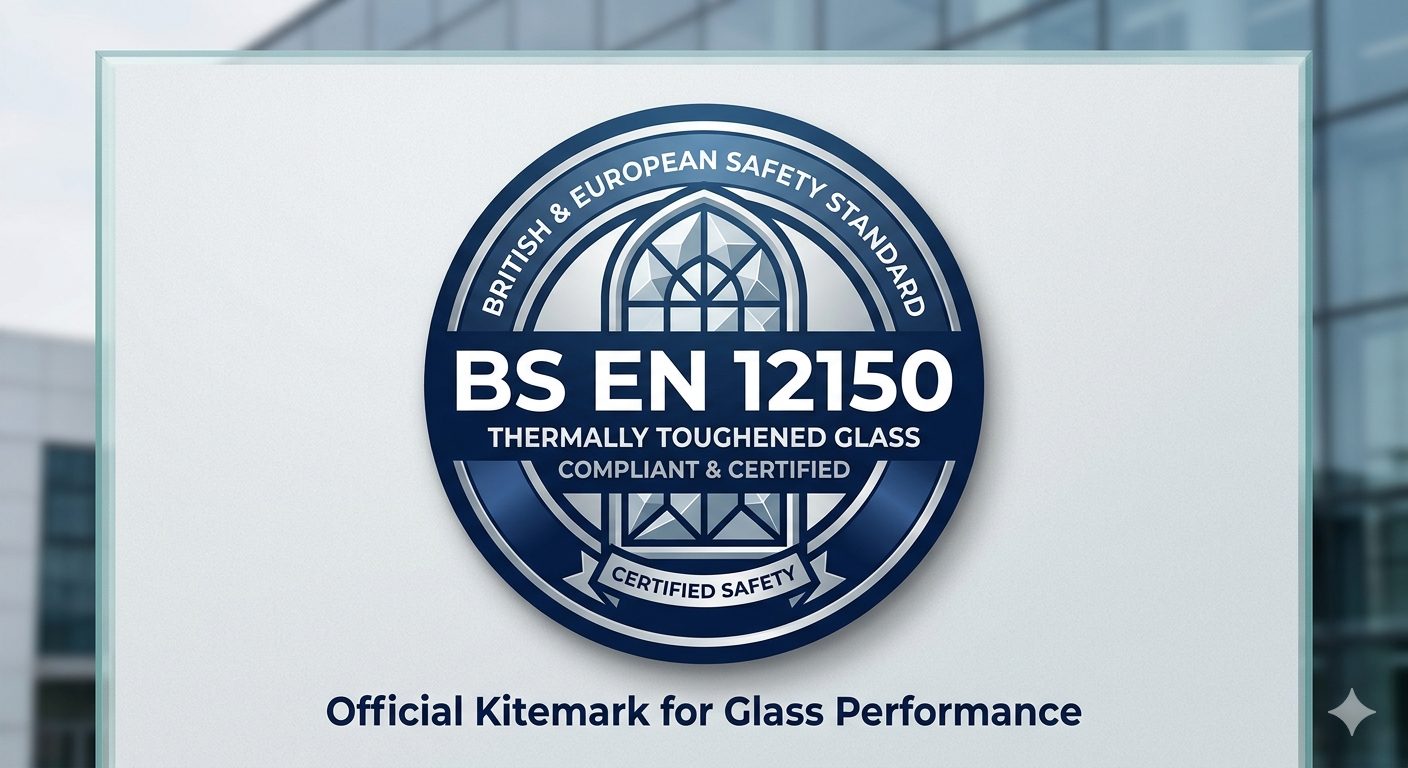
BS EN 12150 is the British and European standard for thermally toughened soda-lime silicate safety glass.
To reach this standard, standard “annealed” glass is heated to approximately 650°C and then rapidly cooled. This process creates intense compressive stress on the surface, making the glass up to five times stronger than standard glass.
Why is it a “Safety” Glass?
The “safety” designation comes from how the glass behaves when it fails.
Key Characteristics:
-
High Strength: Resists heavy impacts and high winds.
-
Thermal Resistance: Can withstand significant temperature fluctuations without cracking.
-
Mandatory Marking: All BS EN 12150 glass must have a permanent, visible stamp (usually in the corner) confirming its compliance.
Other Common Grades of Glazing
While toughened glass is the “gold standard” for impact resistance, other glazing grades serve different functional needs like security, acoustics, or fire protection.
1. Laminated Glass (BS EN 14449)
Laminated glass is made by sandwiching a plastic interlayer (usually PVB) between two sheets of glass.
-
How it breaks: When struck, the glass cracks but stays stuck to the plastic interlayer, maintaining a barrier.
-
Best for: Shop fronts, high-security windows, and overhead glazing where falling glass would be dangerous.
2. Heat-Soaked Toughened Glass (BS EN 14179)
Standard toughened glass can occasionally suffer from “spontaneous combustion” due to tiny nickel-sulphide inclusions. Heat-soaking is an extra testing phase where the glass is “cooked” in an oven for several hours to force any unstable panes to break in the factory rather than on-site.
3. Fire-Rated Glass
Standard toughened glass is not fire-resistant.
4. Acoustic Glazing
This uses a special “acoustic” interlayer within a laminated pane. It is specifically designed to dampen sound frequencies, making it ideal for homes near busy roads or airports.
Summary Comparison Table
| Glass Type | Standard | Primary Benefit | Break Pattern |
| Toughened | BS EN 12150 | Impact Strength | Small blunt granules |
| Laminated | BS EN 14449 | Security & Safety | Cracks but stays in place |
| Heat-Soaked | BS EN 14179 | Stability/Reliability | Same as Toughened |
| Annealed | N/A | Low Cost | Large sharp shards |
When Do You Legally Need Safety Glass?
In the UK, Part K of the Building Regulations dictates where safety glass (like BS EN 12150) must be used.
-
Any glass in a door (up to 1500mm from floor level).
-
Glass adjacent to a door (within 300mm of the door edge).
-
Low-level windows (any glazing below 800mm from the floor).
If you are replacing a window in any of these areas, ensuring it carries the BS EN 12150 or BS EN 14449 mark is not just a good idea—it is the law.